Matrix & Algebra Calculators
Published: 15 November 2026 · Updated: 15 November 2026
Matrices solve systems of equations and quadratics solve parabolas — the algebra core of college mathematics. The free tools below do matrix arithmetic with working shown, solve any quadratic including complex roots, and refuse to invent an inverse when none exists.
The determinant decides. Non-zero determinant: one solution, one inverse. Zero: no inverse, no unique solution. The matrix tool shows the determinant and its working for every matrix you enter.
Researched by MixKhazana Team · Last updated 15 November 2026 · Data: OpenStax Algebra and Trigonometry; OpenStax Intermediate Algebra 2e §9.3
What are matrix and algebra calculators?
Matrices are grids of numbers that encode systems of equations, transformations and data — and matrix calculators do arithmetic with whole grids at once: adding, multiplying, and finding determinants and inverses. A system of equations can be written as A·x = b, and when the coefficient matrix A has an inverse, the solution is a single multiplication: x = A⁻¹·b. That idea runs through linear algebra, computer graphics, economics and engineering, which is why college algebra and precalculus textbooks teach determinants, inverses and Cramer's rule as core skills rather than curiosities.
Quadratic equations belong in the same category because they answer the same kind of question one variable at a time: where does this curve meet the axis? The quadratic formula solves every quadratic without exception, and its discriminant predicts the answer type before the arithmetic is finished. Together, the matrix and quadratic tools cover the algebra core of the first two college mathematics years.
Tools in this category
Free Matrix Calculator
Add, multiply, determinant, inverse and transpose for 2×2 and 3×3 matrices, with working shown.
Open →
Free Quadratic Equation Calculator
Roots, discriminant, vertex and axis for any quadratic, including complex roots.
Open →
Free Graphing Calculator
See the parabola behind the quadratic and the geometry behind the system.
Open →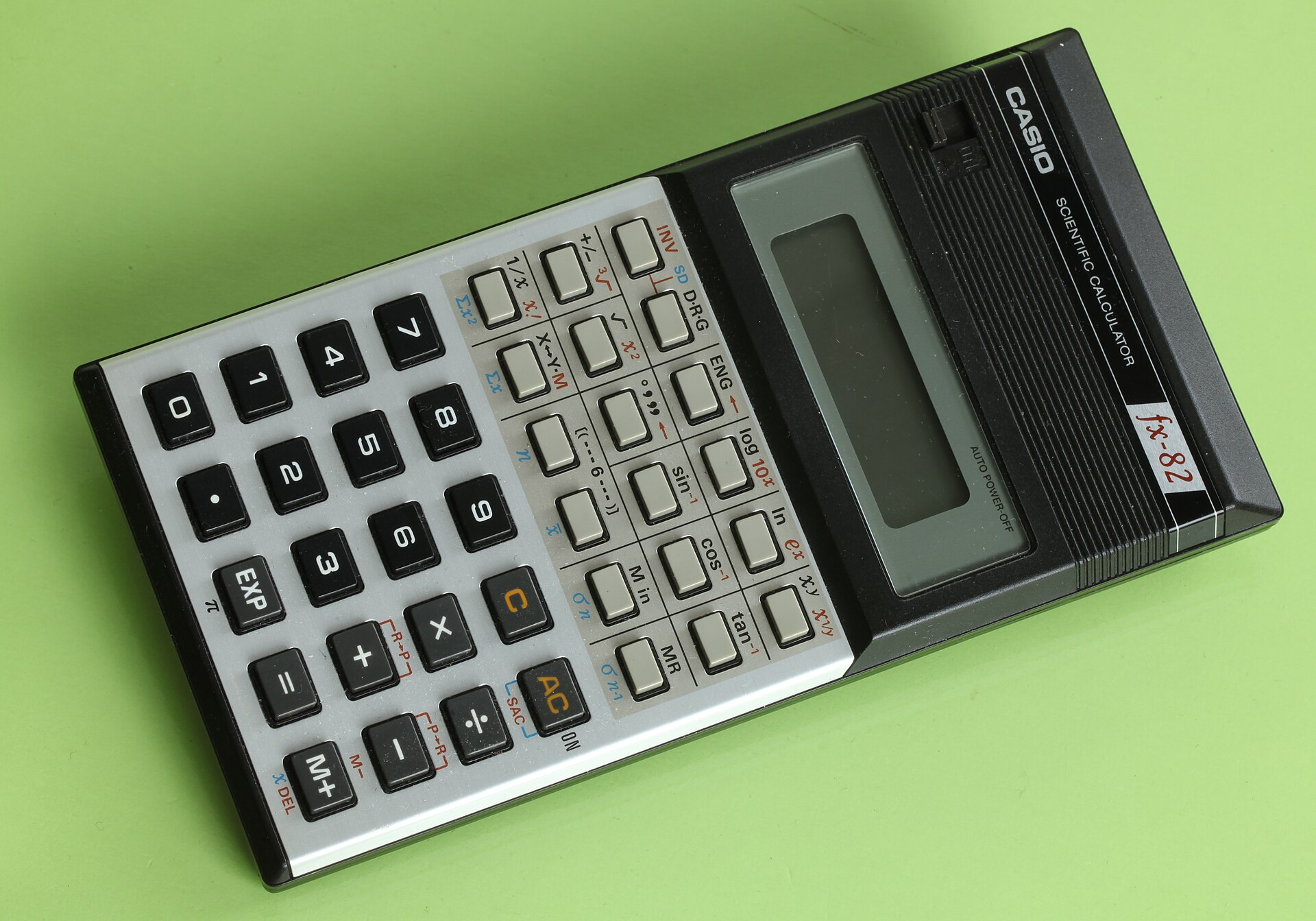
Free Scientific Calculator
Powers, roots and trig for the values inside matrix and algebra work.
Open →Card photos: Yulia Meshkova / Wikimedia Commons, CC BY 4.0 · Coyau / Wikimedia Commons, CC BY-SA 3.0 · Sergey Meshkov / Pexels, Pexels licence · Joost J. Bakker / Wikimedia Commons, CC BY 2.0
The determinant decides everything
| Determinant | What it means |
| det(A) ≠ 0 | A has an inverse; the system A·x = b has exactly one solution |
| det(A) = 0 | A is singular — no inverse; the system has no solution or infinitely many |
| D = b² − 4ac > 0 | The quadratic has two distinct real roots |
| D = 0 | One real double root; the parabola touches the axis at its vertex |
| D < 0 | Two complex roots; the parabola never reaches the axis |
Solving a system, start to finish
Take 4x + 7y = 1 and 2x + 6y = 3. The coefficient matrix is A = [[4, 7], [2, 6]] with det(A) = 4×6 − 7×2 = 10, which is not zero, so exactly one solution exists. The inverse is A⁻¹ = (1/10)[[6, −7], [−2, 4]] = [[0.6, −0.7], [−0.2, 0.4]], and the solution is x = A⁻¹·b = [−1.5, 1]. Check: 4(−1.5) + 7(1) = 1 ✓ and 2(−1.5) + 6(1) = 3 ✓. Cramer's rule reaches the same answer as ratios of determinants. The matrix tool performs every step of this working — and when the determinant is zero, it says there is no inverse instead of printing a wrong matrix.
Why matrix multiplication order matters
Unlike ordinary numbers, matrices do not commute: A × B usually differs from B × A, because rows of the first matrix meet columns of the second. Swapping the order pairs different numbers. Students who carry the commutativity habit from arithmetic into matrices produce wrong answers that look plausible — the matrix tool's multiply operation is the fastest way to see the difference on your own numbers.
Frequently asked questions
What is a matrix used for?
A matrix is a grid of numbers that can encode a system of equations, a geometric transformation, or a table of data. Matrix arithmetic lets you solve systems, compose transformations and manipulate data with single operations on whole grids.
How do matrices solve systems of equations?
Write the system as A times x equals b, where A holds the coefficients. If A has an inverse, the solution is x = A-inverse times b. If the determinant is zero, there is no unique solution.
What does the determinant tell me?
Whether a matrix has an inverse (only when the determinant is not zero) and whether a system has a unique solution. For 2x2 matrices det(A) = ad - bc; for 3x3 it is the cofactor expansion taught in textbooks.
Why does order matter in matrix multiplication?
Because the entry in row i, column j of A x B is row i of A dotted with column j of B. Swapping the order pairs different rows with different columns, so A x B and B x A are generally different matrices.
What is Cramer's rule?
A method that solves a system as ratios of determinants: each unknown equals the determinant of the coefficient matrix with one column replaced by the constants, divided by the determinant of the coefficient matrix. It needs a non-zero determinant.
What is the quadratic formula?
For ax squared + bx + c = 0, x = (-b plus or minus the square root of (b squared - 4ac)) divided by 2a. It solves every quadratic, and the discriminant b squared - 4ac predicts whether the roots are real or complex.
How are matrices and quadratics connected?
Both answer 'where does this meet the axis' questions: matrices for systems of straight-line equations, quadratics for parabolas. Both use a determinant-like quantity — det(A), and the discriminant — to predict the answer type in advance.
What should I do when the determinant is zero?
Stop and think: there is no inverse and no unique solution. Use elimination to find out whether the system has no solution or infinitely many. A tool that prints an inverse for a singular matrix is wrong.
Sources
- OpenStax, Algebra and Trigonometry, Solving Systems with Cramer's Rule — 2 × 2 and 3 × 3 determinants and Cramer's rule.
- OpenStax, Intermediate Algebra 2e §9.3, Solve Quadratic Equations Using the Quadratic Formula — the quadratic formula and discriminant rules.
Disclaimer: a study guide. The linked tools are homework and revision aids, not approved exam-room devices; check your exam board's calculator policy before exam day.