Free Financial Calculator
Published: 15 November 2026 · Updated: 15 November 2026
Solve any time value of money problem: give four of N, I/Y, PV, PMT and FV, and this tool finds the fifth — including the interest rate. It starts with a 10,000 loan over 60 months at 0.5% a month, giving a payment of 193.33. The same five-key work students do on expensive financial calculators, free in your browser.
Four values in, the fifth out. Pick what to solve for, enter the other four with the sign rule (money in positive, money out negative), and the answer appears instantly — including the interest rate, found by search.
Researched by MixKhazana Team · Last updated 15 November 2026 · Data: Business LibreTexts, Time Value of Money; College Board AP calculator policy
What is a financial calculator?
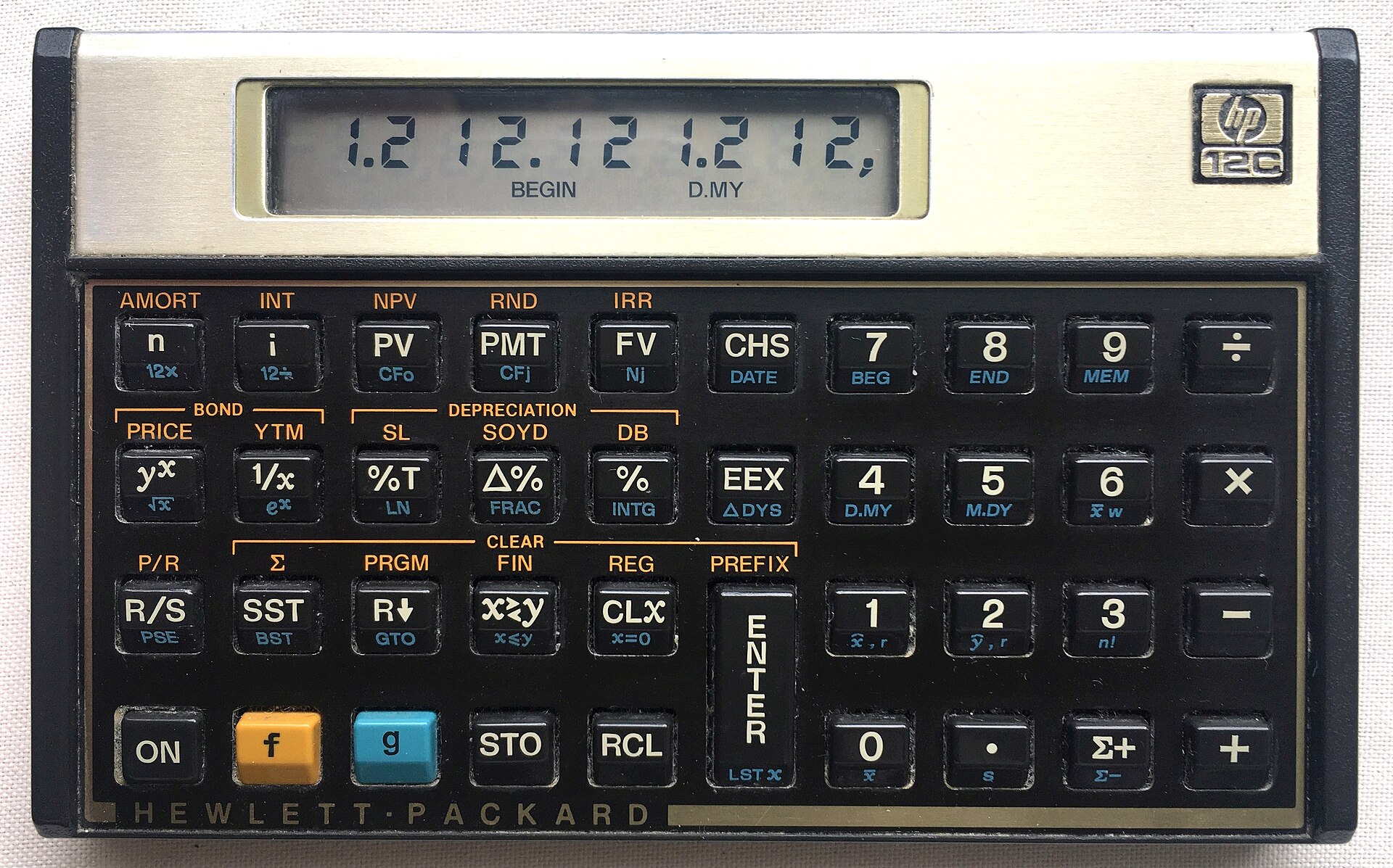
A financial calculator solves time value of money problems: it works out what money today is worth in the future, what future money is worth today, or what regular payment connects the two. Finance and accounting courses require one, and professional finance exams allow only dedicated financial calculators in the exam room. The five keys on such a device — N, I/Y, PV, PMT and FV — are the five values in one equation, and the calculator finds whichever one you leave unknown. This free tool does exactly that, with the same sign rule, for coursework and revision.
Money has a time value because money held today can earn interest: 1,000 today at 8% is worth more than 1,000 received in a year. Every loan payment, savings plan, bond price and pension calculation is built on this one idea, which is why finance textbooks introduce it before anything else.
How to use this financial calculator
- Choose what to solve for: the payment, the future value, the present value, the number of periods, or the interest rate.
- Fill in the other four values. The rate is per period: for a monthly loan at 6% a year, enter 0.5, not 6.
- Pick whether payments come at the end of each period (ordinary annuity: most loans) or the beginning (annuity due: most rents).
- Follow the sign rule: money you receive is positive, money you pay is negative. The answer appears instantly, with the solved box filled in.
Time value of money formulas
Let i be the interest rate per period (as a decimal), N the number of periods, PV the present value, PMT the regular payment, and FV the future value. With payments at the end of each period, the five values are tied together by one equation:
- Master equation: FV + PV × (1 + i)N + PMT × ((1 + i)N − 1) / i = 0
- Future value of a lump sum: FV = PV × (1 + i)N
- Present value of a lump sum: PV = FV / (1 + i)N
- Future value of an ordinary annuity: FVA = PMT × ((1 + i)N − 1) / i
- Present value of an ordinary annuity: PVA = PMT × (1 − (1 + i)−N) / i
When payments come at the beginning of each period (annuity due), the annuity terms are multiplied by (1 + i), because every payment earns one extra period of interest. When the rate is 0%, the equation collapses to simple addition: FV + PV + PMT × N = 0. The rate I/Y has no closed-form solution, so this tool finds it by a bracketed search that narrows in on the rate where the equation balances — the same answer a handheld device reaches by iteration.
Worked example
A student borrows 10,000, to be repaid over 60 months at 6% per year, compounded monthly, with nothing left at the end. What is the monthly payment?
- Rate per period: i = 6% ÷ 12 = 0.5% = 0.005; N = 60; PV = +10,000 (received); FV = 0
- Payment formula: PMT = −PV × i / (1 − (1 + i)−N) = −10,000 × 0.005 / (1 − 1.005−60)
- 1.005−60 = 0.74137, so PMT = −50 / 0.25863 = −193.33
- The minus sign means 193.33 leaves the borrower's pocket each month; total paid is 60 × 193.33 = 11,599.80, so the interest cost is 1,599.80
Try it above: solve for PMT with N = 60, I/Y = 0.5, PV = 10000, FV = 0.
Future value of 1,000 at fixed rates
| Years | At 5% per year | At 8% per year |
| 5 | 1,276.28 | 1,469.33 |
| 10 | 1,628.89 | 2,158.92 |
| 20 | 2,653.30 | 4,660.96 |
| 30 | 4,321.94 | 10,062.66 |
Each value is 1,000 × (1 + rate)years, compounded once a year. The 8% column grows more than twice as fast over 30 years — the power of compounding, and of the rate.
Ordinary annuity or annuity due?
Most textbook loan problems use end-of-period payments: you borrow, a month passes, then you pay. Rent and lease problems usually use beginning-of-period payments: you pay first, then use the flat. The difference is exactly one period of interest on every payment, which is why the annuity-due formulas carry the extra (1 + i) factor. If your answer is off by a factor of (1 + i) from the textbook's, the payment timing is almost always the reason — switch the timing box and compare.
Frequently asked questions
What do N, I/Y, PV, PMT and FV mean?
N is the number of periods, I/Y is the interest rate per period as a percent, PV is the value today, PMT is the regular payment each period, and FV is the value at the end. Give any four and this tool solves for the fifth.
Should the interest rate be yearly or monthly?
Per period, matching N. If N counts months, I/Y must be the monthly rate: 6% a year compounded monthly is 0.5% per month. Mixing a yearly rate with monthly periods is the most common time-value mistake.
Why is my payment negative?
The sign rule: money received is positive and money paid out is negative. A loan you receive (+PV) is repaid with negative payments (-PMT). The size of the number is the payment; the sign only says which way the money flows.
What is the difference between an ordinary annuity and an annuity due?
In an ordinary annuity payments come at the end of each period, as with most loans. In an annuity due they come at the beginning, as with most rents. Annuity-due values are the ordinary-annuity values multiplied by (1 + i).
How is the interest rate solved when there is no formula?
The rate cannot be isolated with algebra alone, so the tool searches: it tests rates across a wide range, finds where the time-value equation changes sign, then narrows that bracket until the rate is accurate to four decimal places.
What if the rate is 0%?
Then there is no interest and the equation is simple addition: FV + PV + PMT x N = 0. The tool handles this case separately so it never divides by a zero rate.
Can I use this for exam practice?
Yes, for practice and homework. Professional finance exams allow only specific approved handheld financial calculators in the exam room, so practise the same sign rule and keystrokes here, then use an approved device on exam day.
Why does the tool say there is no solution?
Usually the signs are wrong: if PV and PMT have the same sign, the balance can never reach the target FV. Flip one sign so money in and money out oppose each other, and check that the payment is large enough to cover the interest each period.
Sources
- Business LibreTexts, Time Value of Money — compound interest, present value, future value, and ordinary-annuity and annuity-due formulas used by this tool.
- College Board, AP Exams Calculator Policy — how exam boards control which calculators may be used in exam rooms, and why study tools and exam devices are different things.
Disclaimer: a study aid for coursework and revision. It is not financial advice, and it is not an approved exam-room device; check your course and exam board rules before exam day.
Related tools

Free Compound Interest Calculator
Savings growth with EU rate presets and a year-by-year table.
Open →
Card photos: Сергей Михель / Wikimedia Commons, CC BY-SA 3.0 · McElspeth / Wikimedia Commons, CC0