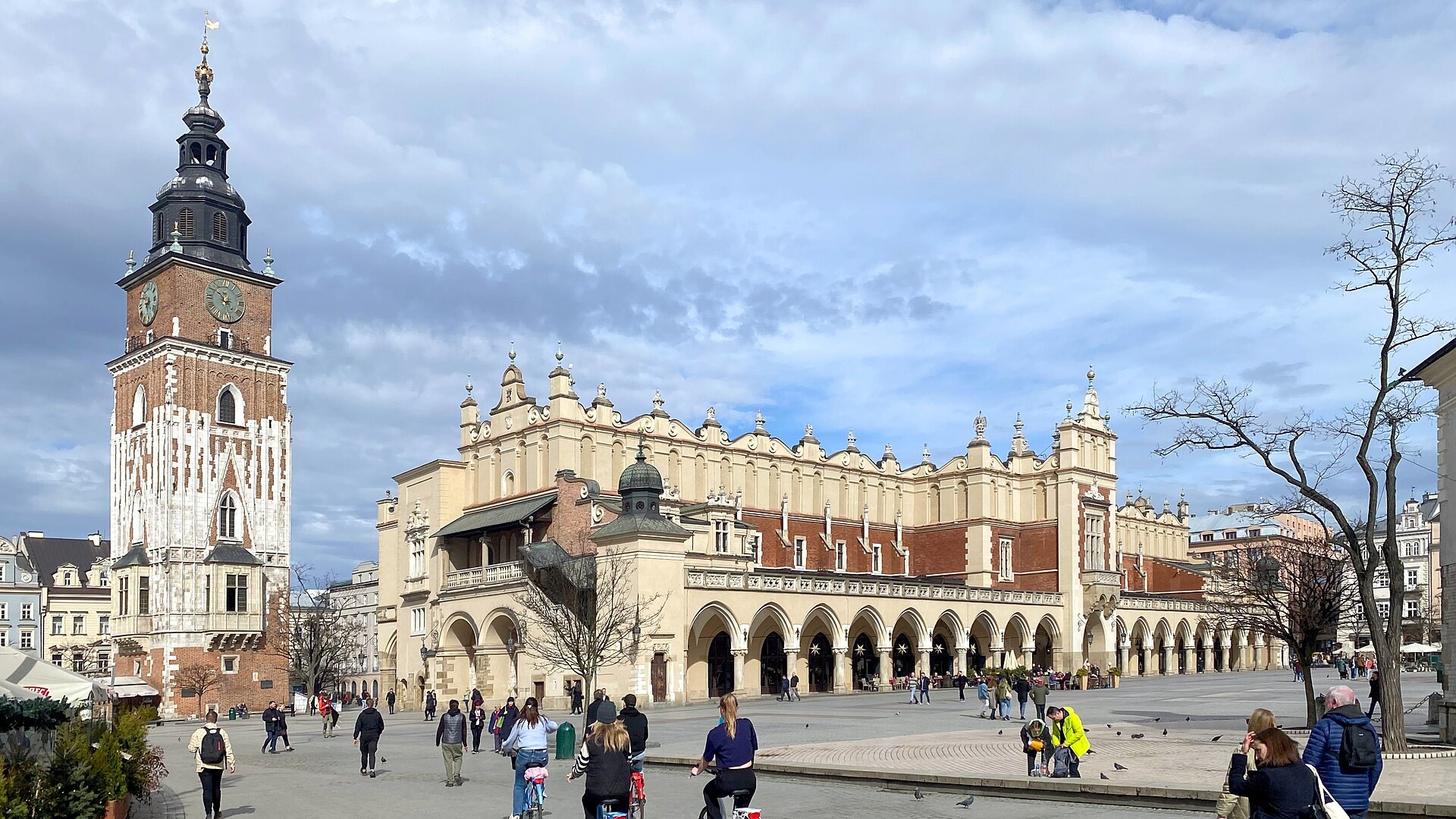
On a Saturday afternoon in one of Europe's most visited historic squares, a gunman opened fire at random. Six people were killed and 15 were injured in Kraków's Main Market Square on 7 November 2026, in the deadliest shooting Poland has seen in decades. Police shot the attacker within minutes of the first reports. He died in hospital early on Monday 9 November. Three more bodies — his parents and his sister — were later found at the family home, about 200 kilometres away. Poland declared two days of national mourning, and the square, which had been full of tourists and shoppers, reopened to the public on Sunday under a heavy police presence.
This article sets out what happened, in the order it became known, using the statements of the Polish police, the interior ministry and the prosecutors, and the reporting of Reuters and the Associated Press. Where the figures differ between sources, that is said plainly.
What happened on Saturday afternoon
Police said they started to receive reports at around 3 p.m. local time (2 p.m. GMT) on Saturday 7 November that an assailant had opened fire from a car and was shooting at random at people in the Main Market Square — Rynek Główny — in the historic heart of Kraków, Poland's second-largest city and one of its main tourist destinations. Unverified footage on social media showed shooting in the square as traditional horse-drawn carriages, popular with tourists, passed through or stood parked nearby.
Police officers reached the scene within minutes. The gunman was shot by police during his arrest near the junction of Dietla and Stradomska streets, close to the square, and was taken to hospital in a critical condition. Two police officers were wounded while subduing him. Prime Minister Donald Tusk later named the two officers as Senior Constables Jakub Kulik and Artur Morański. Police launched a blood appeal for Officer Kulik.
By Saturday evening, the scale of the attack was clear. Six people had been killed in the square — four women and two men — and 15 people had been injured. The dead included a British citizen, the Associated Press reported. Polish media reported that the victims included three Polish women, aged 61, 53 and 47, a Polish man aged 50, and a British man aged 32, with one woman's identity still being checked; Polish news agency PAP reported the victims as four Polish nationals, a British citizen and an Austrian woman. Their names had not been officially released. Five of the injured were foreign nationals, from Austria, Germany, Portugal, Russia and Britain, the interior ministry told Reuters. The Portuguese foreign ministry said a Portuguese woman was among the injured and was in hospital.
A note on the casualty figures
Readers may see different numbers for the injured, and the reason is how the wounded suspect is counted. Polish police put the injured at 15 people. Some later reports gave 16, counting the wounded suspect among the injured. Reuters put the total at 17, including the suspect and the two wounded police officers. The number of people killed in the square — six — is not in dispute. This article uses the police figure of 15 injured, and says where other counts differ.
The gunman and what happened to him
Police identified the suspect as a 24-year-old Polish citizen, named in Polish media only as Michał O. He held a firearms licence, and police said he used an AR-15 rifle. He had no previous criminal record. Reuters reported that he appeared to be a highly skilled marksman, according to a member of the Swit Starachowice sports shooting club where he trained.
After being shot by police, the suspect was taken to hospital, where he underwent at least three operations. His condition was critical from Saturday. On Monday morning, 9 November, police in the Małopolska region said he had died in hospital early that morning. The governor of the region, Krzysztof Klęczar, said the suspect had died at about 4:30 a.m. The police statement said 15 people remained in hospitals, 14 of them in a stable condition and one — a police officer who took part in the arrest — in a serious condition. Autopsies of the victims began on Monday and were expected to take about two days.
Under Polish law the suspect, who was never charged, is presumed innocent. That matters for how the case is described: the facts of what happened in the square are established by the police account and the evidence, but the question of his guilt was never tested in court, because he died before any charge could be brought.
Three more bodies at the family home
On Saturday, Prime Minister Tusk said that the bodies of two women and one man had been found at the shooter's home in Ostrowiec Świętokrzyski, a town just under 200 kilometres north of Kraków. On Sunday, police confirmed that the three were the suspect's father, aged 53, his mother, aged 52, and his sister, aged 21. How and when they died is part of the investigation, and the authorities have not yet said publicly what they believe happened at the house.
The discovery means the total number of people found dead in connection with the case is nine: six in the square and three at the house. The police and prosecutors have not said whether they believe the three at the house were killed before the attack on the square, or in what order events unfolded. That is one of the main open questions for the investigation.
National mourning
A spokesperson for President Karol Nawrocki said the president would declare a period of national mourning on 8 and 9 November. Flags were flown with black ribbons. Kraków's mayor, Łukasz Gibała, declared city mourning until Wednesday 11 November. The Main Market Square reopened to the public on Sunday, just over 24 hours after the attack, as the country began its two days of mourning.
The scenes in the square shocked a nation that has long viewed itself as safer than western European neighbours that have witnessed such attacks in the past. Reuters described "scenes of blood and bodies strewn across the historic heart of one of Poland's main tourist attractions". The square is the centre of Kraków's Old Town, a UNESCO World Heritage site, and on a Saturday afternoon in November it would have been busy with residents, shoppers and tourists.
The investigation and the question of motive
Poland's national prosecutor's office has opened an investigation into what it described as a terrorist offence — "the killing of six people … using a firearm, and the attempted murder of many others, including police officers". Justice Minister Waldemar Żurek said the investigation continues, to establish whether the man acted alone or was inspired by a group.
On the question of motive, two statements need to be kept apart. On Saturday, Interior Minister Marcin Kierwiński told a news briefing: "Everything points to the fact that the shooter was influenced by far-right ideology, a matter that will also be subject to investigation." That was the minister's assessment on the day. By Monday, the National Prosecutor's Office said investigators could not yet link the dead gunman to any ideology, and the investigation into his motives was continuing. Both statements are on the record. The careful reading is that the minister pointed to far-right influence as the leading line of inquiry, while the prosecutors have not yet established a motive — and the public should not treat either statement as a final finding.
The attack also added to a sense of unease built by a string of school stabbings in October, which the authorities said was influenced by violent and extremist content online. Whether the Kraków shooting is connected to that pattern, or to any organised group, is exactly what the investigation is now trying to determine.
What happens next
With the suspect dead, there will be no trial. The investigation will now focus on establishing the full sequence of events: what happened at the family home in Ostrowiec Świętokrzyski, how the suspect obtained and used his weapon, whether anyone else was involved, and what motivated him. The prosecutor's office has said the autopsies of the victims will take about two days, and the investigation is continuing.
For Kraków, the immediate task is recovery. The square has reopened, the city is in mourning until Wednesday, and the country is holding two days of national mourning. For the families of the six people killed in the square — and of the three found dead at the house — the questions the investigation must answer are only beginning. This article will be updated as the prosecutors publish their findings.
🔗 See also
Frequently asked questions
When and where did the Kraków shooting happen?
On Saturday 7 November 2026, at around 3 p.m. local time, in the Main Market Square (Rynek Główny) in the historic Old Town of Kraków, Poland. The gunman opened fire at random from his car.
How many people were killed and injured?
Six people were killed in the square — four women and two men — and 15 people were injured, according to Polish police. Some reports give 16 or 17 injured because they also count the wounded suspect and the two wounded police officers.
Who was the gunman?
A 24-year-old Polish citizen, named in Polish media only as Michał O. Police said he used an AR-15 rifle, held a firearms licence, and had no previous criminal record. He trained at a sports shooting club and was described as a highly skilled marksman.
Is the gunman still alive?
No. He was shot by police within minutes of the attack and died in hospital early on Monday 9 November 2026, after several operations. He was never charged, so under Polish law he is presumed innocent.
Who were the victims?
Four women and two men were killed in the square. One was a British citizen, according to the Associated Press. Polish media reported the others included Polish nationals, and one woman's identity was still being checked. Their names had not been officially released. Five foreign nationals were among the injured.
What about the three bodies found at his home?
Police found three bodies at the suspect's family home in Ostrowiec Świętokrzyski, about 200 kilometres north of Kraków — his father, aged 53, his mother, aged 52, and his sister, aged 21. How and when they died is part of the investigation.
Was it a terrorist attack?
Poland's national prosecutor's office has opened an investigation into what it described as a terrorist offence. The interior minister said everything pointed to the shooter being influenced by far-right ideology, but prosecutors said on Monday that no ideology had yet been established and the investigation continues.
How long is Poland in mourning?
President Karol Nawrocki declared national mourning for 8 and 9 November 2026. Kraków's mayor declared city mourning until Wednesday 11 November. The Main Market Square reopened to the public on Sunday 8 November.
Why did this shock Poland so much?
Poland has long viewed itself as safer than western European neighbours that have suffered mass shootings, and an attack of this scale in a crowded historic square is unprecedented there. It also follows a string of school stabbings in October that the authorities linked to violent extremist content online.
Sources
- Reuters: Poland in shock after six die in Krakow mass shooting (7 Nov 2026)
- Reuters: Poland in shock as six dead after mass shooting in Krakow (8 Nov 2026)
- The Orbit Post: Six killed, 15 injured in shooting in Krakow Main Market Square (updated 9 Nov 2026)
- The Daily Lens: Kraków mourns six as Market Square reopens (9 Nov 2026)
Facts checked against Reuters and Associated Press reporting of 7–9 November 2026. Where casualty counts differ between sources, the difference is explained in the article.